

The Blueprint Of The Court: Understanding Basketball Positions In Modern Basketball
Welcome to Modern Basketball Basics. Here we have a beginner's guide to the five positions played and how they each work individually and how they collaborate.
What are Basketball Positions?
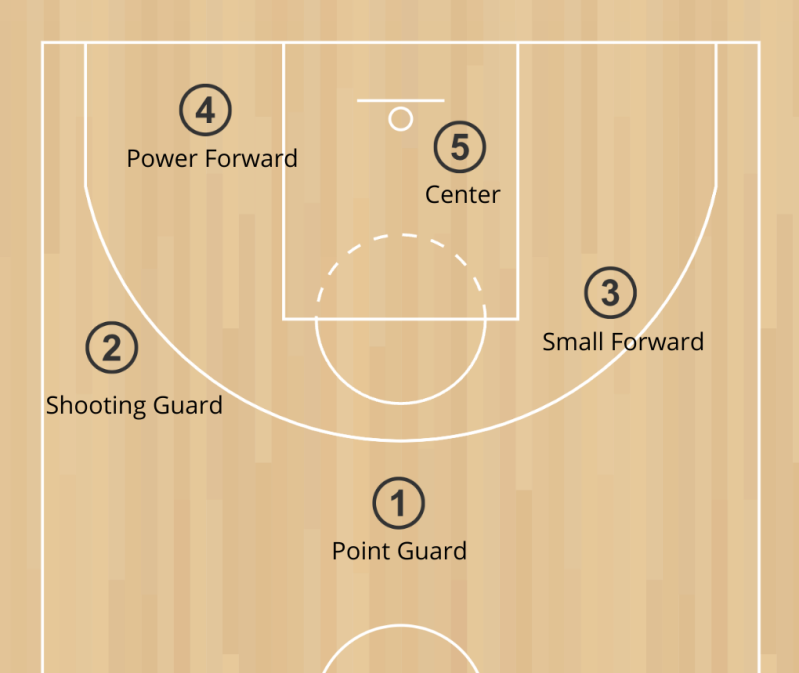
They are the five roles assigned to each player that determine what each player is responsible for on both the offensive and defensive side of the ball. These five roles/positions are important and play a major part in the success of the game as a sport, they provide organization to the game, help highlight individual skills and talents, makes development of defensive and offensive plays possible and builds a successful foundation for teamwork for on court collaboration.

Why Positions matter
The five positions/roles keep the game organized, they help individual players utilize their skill sets and specific talents so everyone can use their natural strengths within the game. Another big reason they are vital is that it heavily improves the coaching aspect of the game. Having set positions makes developing offensive and defensive plays/strategies possible and also allows coaches create and run plays for specific roles to execute. Lastly, this structure of the game builds a foundation for teamwork rather than one player doing everything. It creates on court synergy by having players use their basketball IQ to play to each other's strengths which leads to efficient shots and successful playmaking.
Point Guard(PG)-"The 1"
The point guard position acts as the team's primary facilitator. Unlike the other four positions who focus heavily on scoring the point guard's main job is to coordinate the team and make the game easier for everyone on both sides of the court. They act as a on-court coach/manager that control the pace and flow of the game. They run the offense by making quick and smart decisions. They bring the ball up the court, call out plays, pass the ball to an open teammate and set up opportunities for easy and efficient scoring. On the defensive side of the ball they guard the opposing team's point guard on the three-point line, disrupt the passing lanes, slow down and prevent a quick counter attack. A great example that embodies these traits heavily in today's basketball landscape is "Tyrese Haliburton" of the Indiana Pacers in the NBA.


Shooting Guard(SG)-"The 2"
The shooting guard is the team's primary three-point line scorer. While the point guard brings the ball up the court, the shooting guard moves across the court looking to strictly shoot and score. Their job is to pull defenders away from the basket by shooting from long distance, making it easier for the rest of the team to score anywhere on the court. They act as the secondary ball-handler that can make their own shot and create scoring opportunities for others when the offense is losing momentum. They run the three-point line by taking smart and decisive actions to find open space. They move without the ball, cut to the basket, catch and shoot quickly as well as set up opportunities for highly efficient scoring. On the defensive side, they guard the opposing team's shooting guard on the three-point line, contest any shot attempts and prevent easy passes. An example that heavily embodies this in today's basketball landscape is "Kelsey Mitchell" of the Indiana Fever in the WNBA.
Small Forward(SF)-"The 3"
The small forward position acts as the team's most versatile asset; they bridge the gap between inside the perimeter and outside speed. Their job is to do a bit of everything, making them an all-around threat on the court. They act as another secondary scorer and offensive and defensive rebounder, while also being able to absorb physical contact like a power forward or center. At the same time, they remain agile enough to handle the ball on the three-point line. They run the floor by making use of their strategic agility and natural athleticism, slicing through defenses and driving aggressively to the basket for inside layups, mid-range jump shots, as well as setting up opportunities for highly efficient scoring. On the defensive side, they use their length and height to guard multiple positions from inside the paint to outside on the perimeter, contesting shot attempts and defending the opposing team's most dangerous scoring threat. A great player that exemplifies these qualities in today's game is "OG Anunoby" of the New York Knicks in the NBA.


Power Forward(PF)-"The 4"
The power forward position acts as the team's primary interior backbone. While the small guards control the three point line area with speed, the power forward plays near the basket using their size and strength, operating similarly to a center. Their job is to control the physical area close to the basket making them a powerful presence on the court. They act as the dominant inside scorer and tough rebounder who can take heavy physical contact from opponents. They run the inside area by making rapid and calculated choices utilizing their natural height and strength. They power through defenders, score aggressively on close-range shots, make mid-range shots and set up opportunities for highly physical scoring. On the defensive end, they guard the opposing team's strongest players, block inside shot attempts and re-claim missed balls after a shot. A player that best exemplifies this position in today's basketball landscape is "Anthony Davis" of the Washington Wizards in the NBA.
Center(C)-"The 5"
The center position acts as the team's primary basket protector and ultimate inside enforcer. While the power forward has the ability to move further from the basket, the center almost exclusively plays inside the painted area near the basket. Using size effectively to control the area directly under the basket.Their job is to dominate the territory near the basket, making them an important factor for the teams safety. They act as the primary shot-blocker and rebounder recovering missed balls on both offense and defense. They run the middle area of the court making sharp and instinctive reads utilizing their imposing height. They wall off opponents, score aggressively on dunks and tip-ins and set up opportunities for easy highly efficient scoring. On the defensive side of the ball, they use their towering height and massive reach to protect the basket from incoming opposing players, change the path of opposing players shot attempts and eliminate second chance scoring opportunities. A player that embodies this position in today's basketball landscape is "Rudy Gobert" of the Minnesota Timberwolves in the NBA.


Position-less Basketball
While the five traditional positions give an important foundation for understanding the game, today's basketball landscape is shifting toward a style called "Position-less basketball". This concept represents an evolution of the sport where traditional rules and standards are being constantly broken. Today's athletes are no longer limited their size or height. Big men such as power forwards and centers are now trained to dribble and shoot like smaller guards. At the same time smaller guards are learning to rebound like power forwards and centers. Because players now possess such versatile skill sets the strict boundaries of the five traditional roles are now fading. A Team does not need a traditional pass-only point guard or an exclusively inside the paint center to function. Team's now build line-ups filled with multi-talented players who can swap roles mid-game. This strategic fluidness allows a single player to be the ball-handler that brings up the ball and perimeter scoring threat on one play and act as the inside shot-blocker and rebounder in the next, making a team incredibly difficult to strategize against.
Conclusion
To conclude, basketball positions offer the foundational organization that translates individual talent into synchronized teamwork. While the five traditional positions have evolved dramatically over time, every position remains essential with each role combining unique skill sets to secure a shared victory. Modern "Position-less" basketball has undeniably reshaped the boundaries of player sizes and skill sets, but the game is still anchored by these foundational roles. Whether showcased by a traditional role player or versatile player, mastering ball-handling, three-point shooting, defense and rebounding is what inevitably drives on-court synergy and team success.

References
-
Hedquist, Alexander L., "Redefining NBA Basketball Positions Through Visualization and Mega-Cluster Analysis" (2022). All Graduate Theses and Dissertations. 8602. https://digitalcommons.usu.edu/etd/8602
- Strickland, Mark. "Positions in Basketball." SportsEdTV, 24 Mar. 2023, https://sportsedtv.com/blog/positions-in-basketball
- "Basketball Fundamentals." USA Basketball, https://www.usab.com
- "NBA.com." National Basketball Association, https://www.nba.com
- "Basketball Reference." Sports Reference LLC, https://www.basketball-reference.com
- "Basketball." Encyclopaedia Britannica, https://www.britannica.com/sports/basketball
Image's credit
- Basketball court diagram with positions, Source: rockstaracademy.com/blog/basketball-position-roles-and-responsibilities
- Team line-up image with each position, Source: nbapassion.com/nba/nba-starting-five-come-cambiano-quintetti-24150/
- Point guard position illustration, Source: Britannica.com//biography/Tyrese-Haliburton
- Shooting guard illustration, Source: wishtv.com/sports/indiana-fever/kelsey-mitchell-wins-player-of-the-week/
- Small forward illustration, Source: nypost.com/2024/03/13/sports/og-anunoby-provides-reminder-of-how-important-his-health-is/
- Power forward illustration, Source: wreg.com/sports/ap-sports/ap-lakers-rule-out-anthony-davis-with-low-back-tightness/
- Center illustration, Source: nba.com/timberwolves/photos/wolves-pics-rudy-gobert-23-24-season-photos
- "Position-less" illustration, Source: 365scores.com/news/lebrons-end-is-near
- Conclusion illustration, Source: usab.com/news/2026/01/2025-sees-usa-basketball-youth-and-sport-development-growth
Contact us
Modern Basketball Basics
Seattle, Washington, United States
Email: Elyas.Elmi@bellevuecollege.edu
Create Your Own Website With Webador